Certificates, treatment and buying with confidence
Why the report is the line between a natural rarity and a treated lookalike — what each lab decides, how to spot treatment, and a checklist for buying safely.
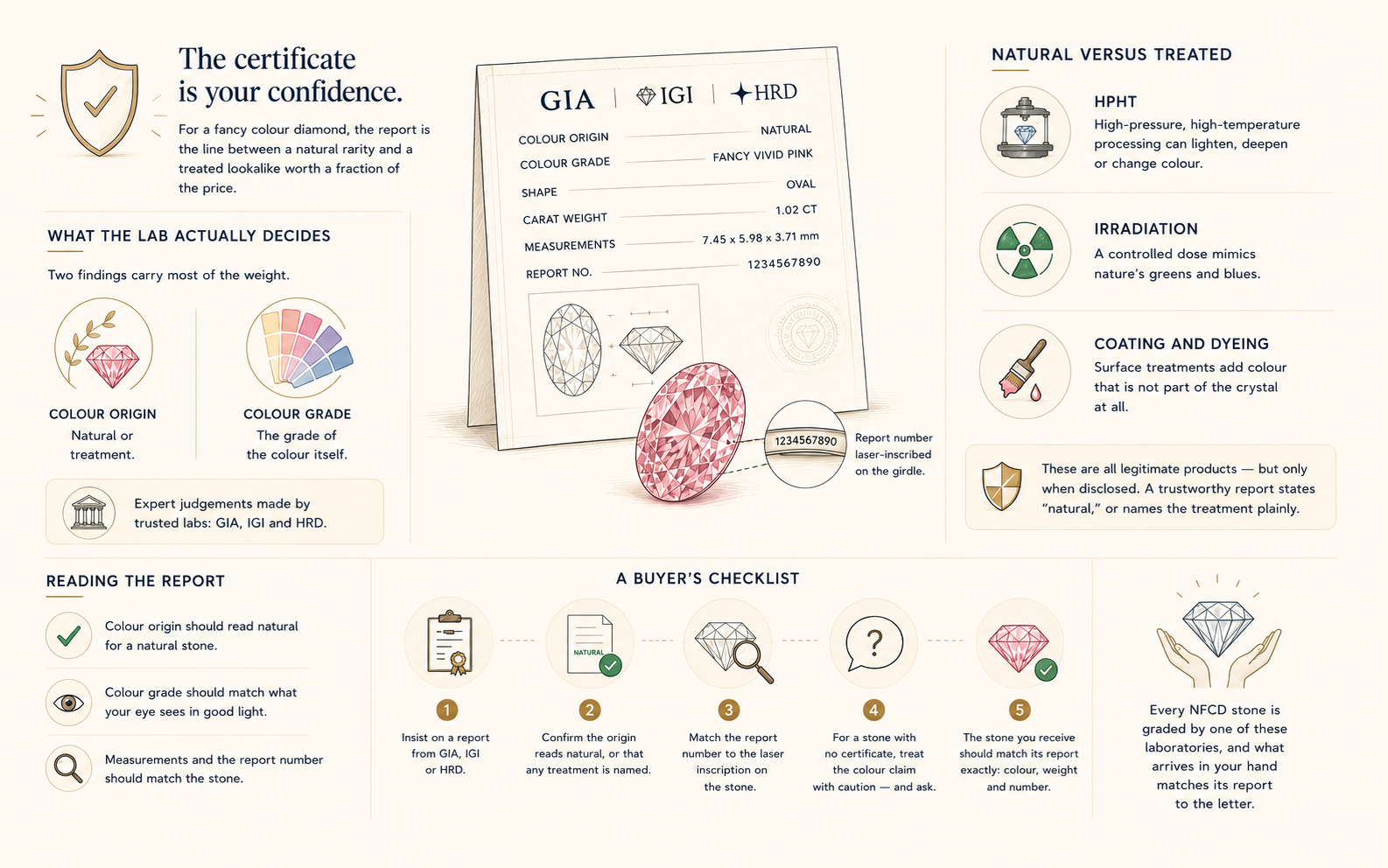
For a fancy colour diamond, the certificate is not paperwork — it is the line between a natural rarity and a treated lookalike worth a fraction of the price.
What the lab actually decides
Two of the report's findings carry most of the weight: the colour origin — whether the colour is natural or has been induced — and the colour grade itself. Both are expert judgements, which is why the trade relies on a small number of laboratories — GIA, IGI and HRD — to make them.
Natural versus treated
- HPHT — high-pressure, high-temperature processing can lighten, deepen or change a diamond's colour.
- Irradiation — a controlled dose mimics nature's greens and blues.
- Coating and dyeing — surface treatments add colour that is not part of the crystal at all.
These are all legitimate products — but only when disclosed. A trustworthy report states "natural," or names the treatment plainly. A treated stone can be beautiful, yet it is worth a small fraction of its natural equivalent, so the distinction is everything.
Reading the report
- Colour origin should read natural for a natural stone.
- Colour grade should match what your eye sees in good light.
- Measurements and the report number should match the stone — many are laser-inscribed on the girdle.
A buyer's checklist
- Insist on a report from GIA, IGI or HRD.
- Confirm the origin reads natural, or that any treatment is named.
- Match the report number to the laser inscription on the stone.
- For a stone with no certificate, treat the colour claim with caution — and ask.
The stone you receive should match its report exactly: colour, weight and number.
Every NFCD stone is graded by one of these laboratories, and what arrives in your hand matches its report to the letter.
← All primers