What makes a colour diamond rare
A trace of nitrogen, a stray dose of radiation, or a crystal bent under pressure — the tiny accidents that turn an ordinary diamond into one in ten thousand.
In a colourless diamond, colour is a flaw to be graded away. In a fancy colour diamond it is the entire point — and nature creates it only rarely. Fewer than one in ten thousand diamonds pulled from the ground shows colour strong enough to be called fancy.
Born from imperfection
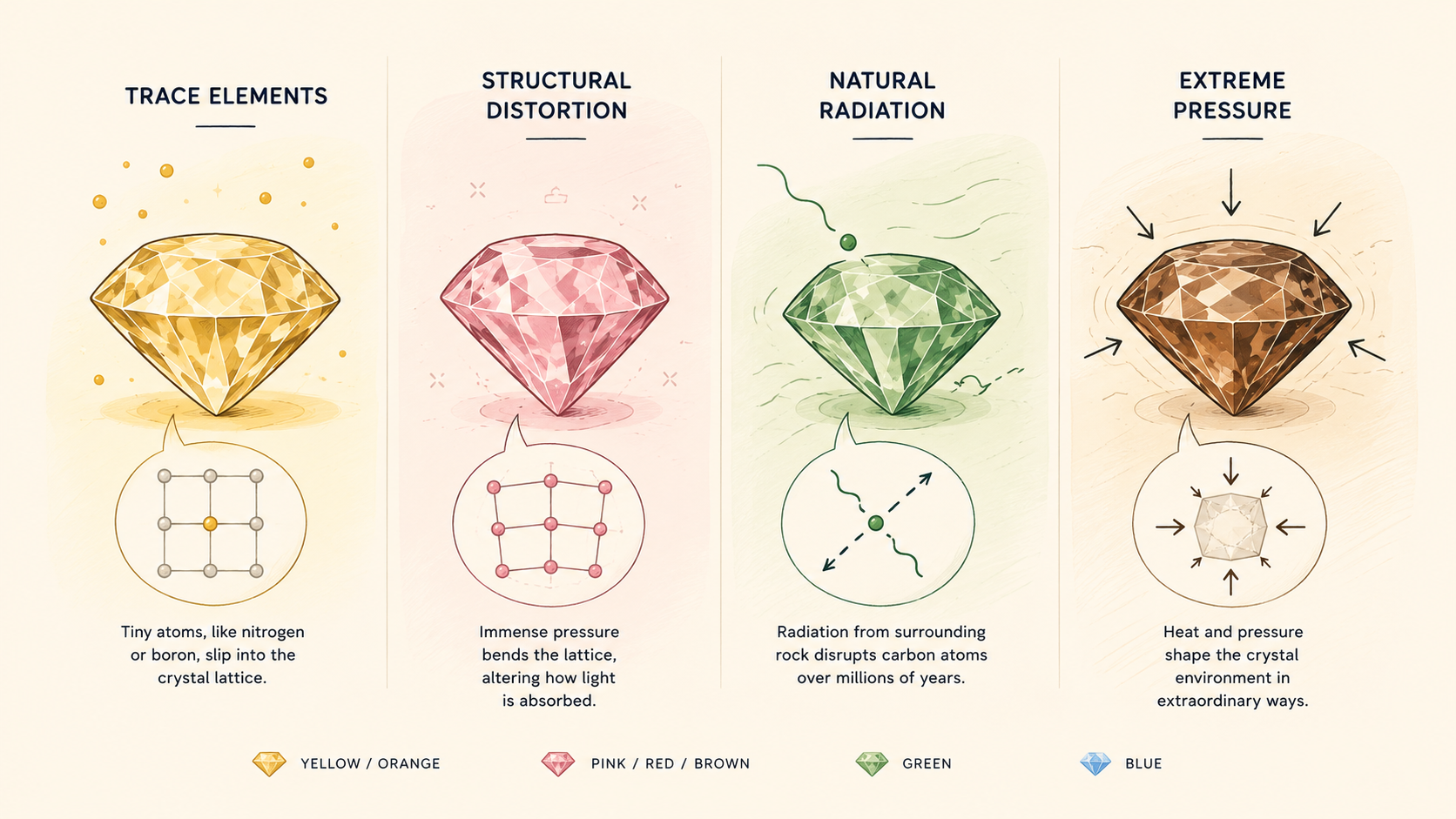
Every diamond is carbon crystallised deep in the earth. A perfect lattice of pure carbon is colourless and lets light pass almost untouched. Colour appears only when that perfection is broken — by a stray atom, a dose of radiation, or the crystal itself bent under heat and pressure. The kind of flaw decides the colour.
Four ways a diamond gets its colour
- Nitrogen sits in place of carbon and absorbs blue light, leaving the diamond yellow or orange. It is the most common colouring element, which is why yellows are the most available fancy colour.
- Boron produces the celebrated blues. It is vanishingly rare in nature, so natural blue diamonds come from only a handful of mines.
- Structural distortion — not an impurity at all — gives pinks, reds and many browns. Immense pressure bends the carbon lattice, and the bent planes absorb light. This is why pink can never be predicted from chemistry alone.
- Natural radiation colours a diamond green as nearby radioactive rock knocks carbon atoms out of place over millions of years. The colour often sits only skin-deep, which makes natural green one of the hardest origins for a lab to confirm.
Why rarity follows geology
Each of these recipes needs conditions that almost never line up. The Argyle mine in Western Australia produced more than nine in ten of the world's pink diamonds — and it closed in 2020, tightening supply for a generation. Blues trace to a few sources such as South Africa's Cullinan mine. Natural reds are so scarce that the entire known population would fit in a single hand.
A one-carat vivid blue or red can be rarer than a flawless ten-carat white — and is priced accordingly.
What it means when you buy
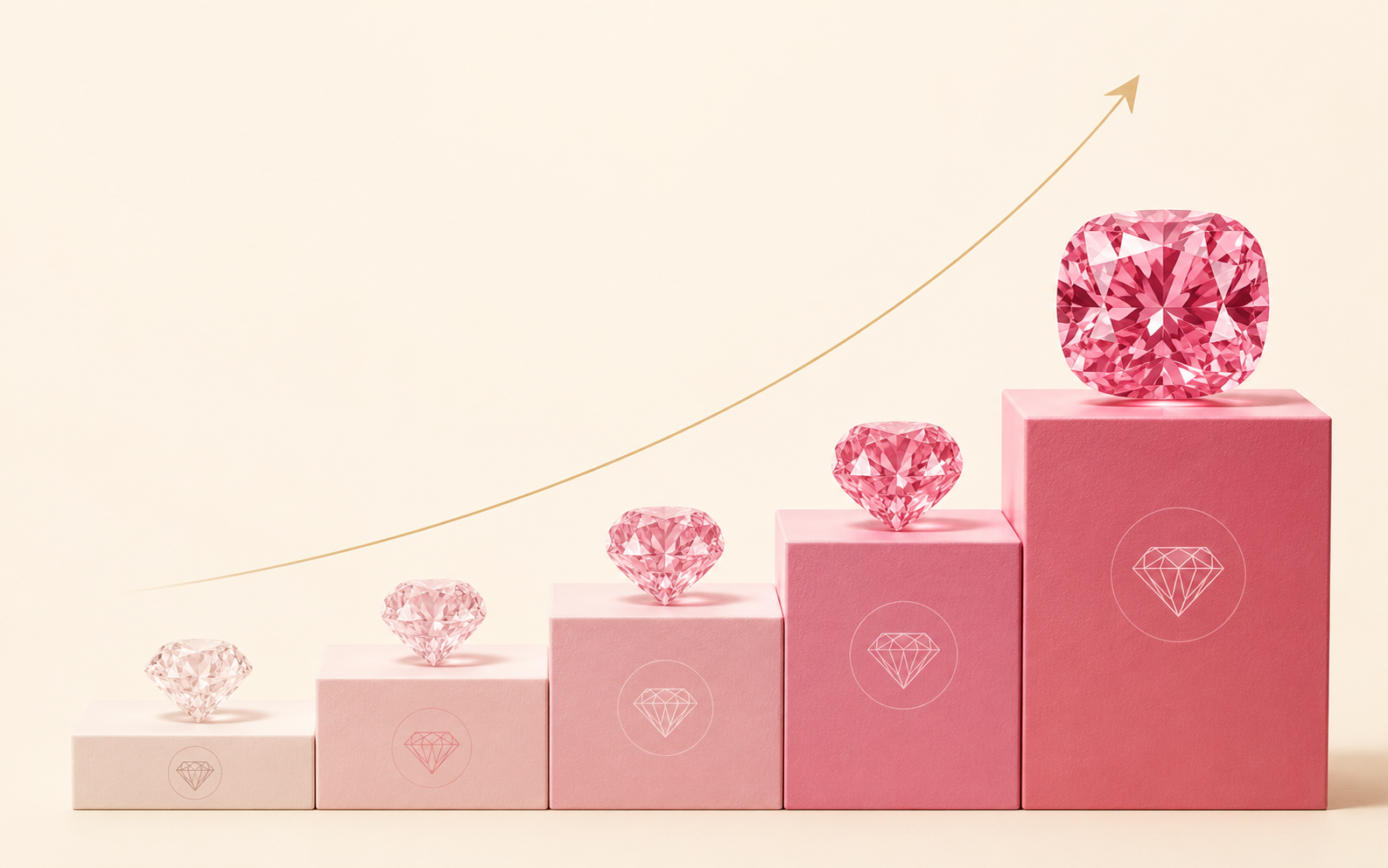
Because the colour itself is the rare event, value concentrates in hue and intensity rather than size. A small stone with a pure, vivid colour will often outprice a far larger one whose colour is faint or muddied. Understanding where a colour comes from is the first step to understanding what it is worth.
← All primers