How a colour diamond is priced
Why the familiar four-Cs grid gives way to a single quality — and how rate, rarity and hue combine into the number on the tag.
Colourless diamonds are priced on a familiar grid where the four Cs pull in roughly equal measure. Fancy colour tears that grid up and rewrites it around a single quality: colour.
Colour comes first
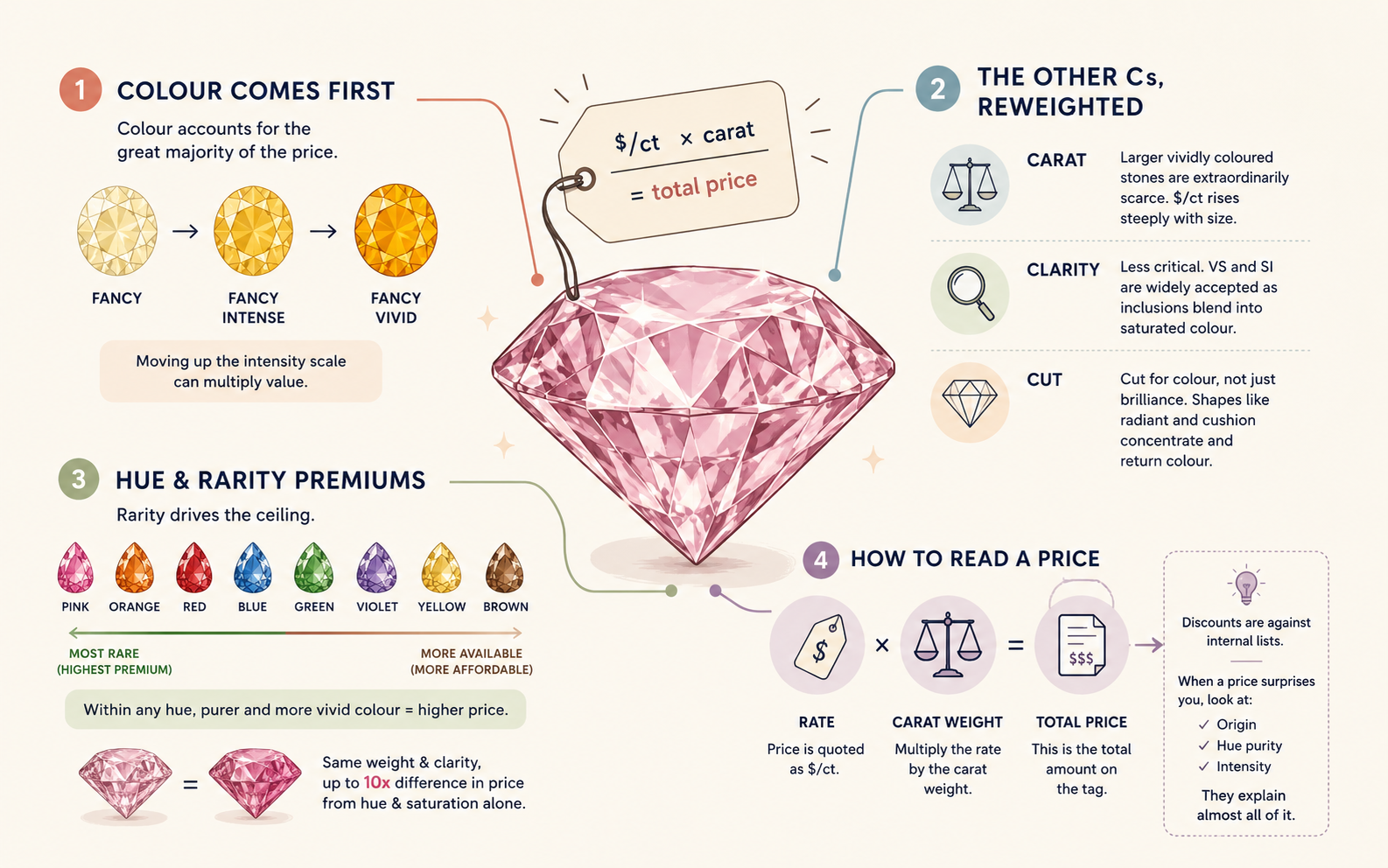
In a fancy colour diamond, colour can account for the great majority of the price. Moving one step up the intensity scale — from Fancy to Fancy Intense to Fancy Vivid — can multiply value, even with everything else held equal. This is why two stones of identical weight and clarity can differ many times over in price.
The other Cs, reweighted
- Carat — price is quoted per carat ($/ct) and multiplied by weight. The per-carat figure itself climbs steeply with size, because large crystals that are also vividly coloured are extraordinarily scarce.
- Clarity — matters less than in colourless stones. Small inclusions often vanish against a saturated colour, so the trade comfortably accepts VS and SI grades that would be penalised in a white diamond.
- Cut — judged by a different goal. A colour cutter shapes the stone to deepen its face-up colour, sometimes trading away a little brilliance to do it. That is why radiants, cushions and other fancy shapes dominate — they concentrate colour and return it to the eye.
Hue and rarity premiums
Hue sets the ceiling. Red, blue, green, violet, orange and pink carry the steepest premiums; yellow and brown are more plentiful and more affordable. Within any hue, the purer and more vivid the colour, the higher the price — a clean "Fancy Vivid Pink" outruns a "Fancy Light Brownish Pink" of the same weight.
Two stones of equal weight and clarity can differ ten-fold in price on hue and saturation alone.
How to read a price
The headline number is the rate: $/ct × carat = total amount. A discount percentage, where shown, is measured against an internal list — the Rapaport sheet that governs colourless goods does not set fancy colour prices. When a stone's price surprises you, ask what is driving it: origin, hue purity and intensity will explain almost all of it.
← All primers