Reading the colour grade
Hue, tone and saturation, the ladder from Faint to Fancy Vivid, and how to decode a phrase like "Fancy Deep Orangy Yellow" before you ever see the stone.
A fancy colour grade looks like a short phrase — "Fancy Vivid Yellow" — but it packs three separate judgements into a few words. Learn to unpack it and you can read most of a stone's character before you ever see it.
Hue, tone and saturation
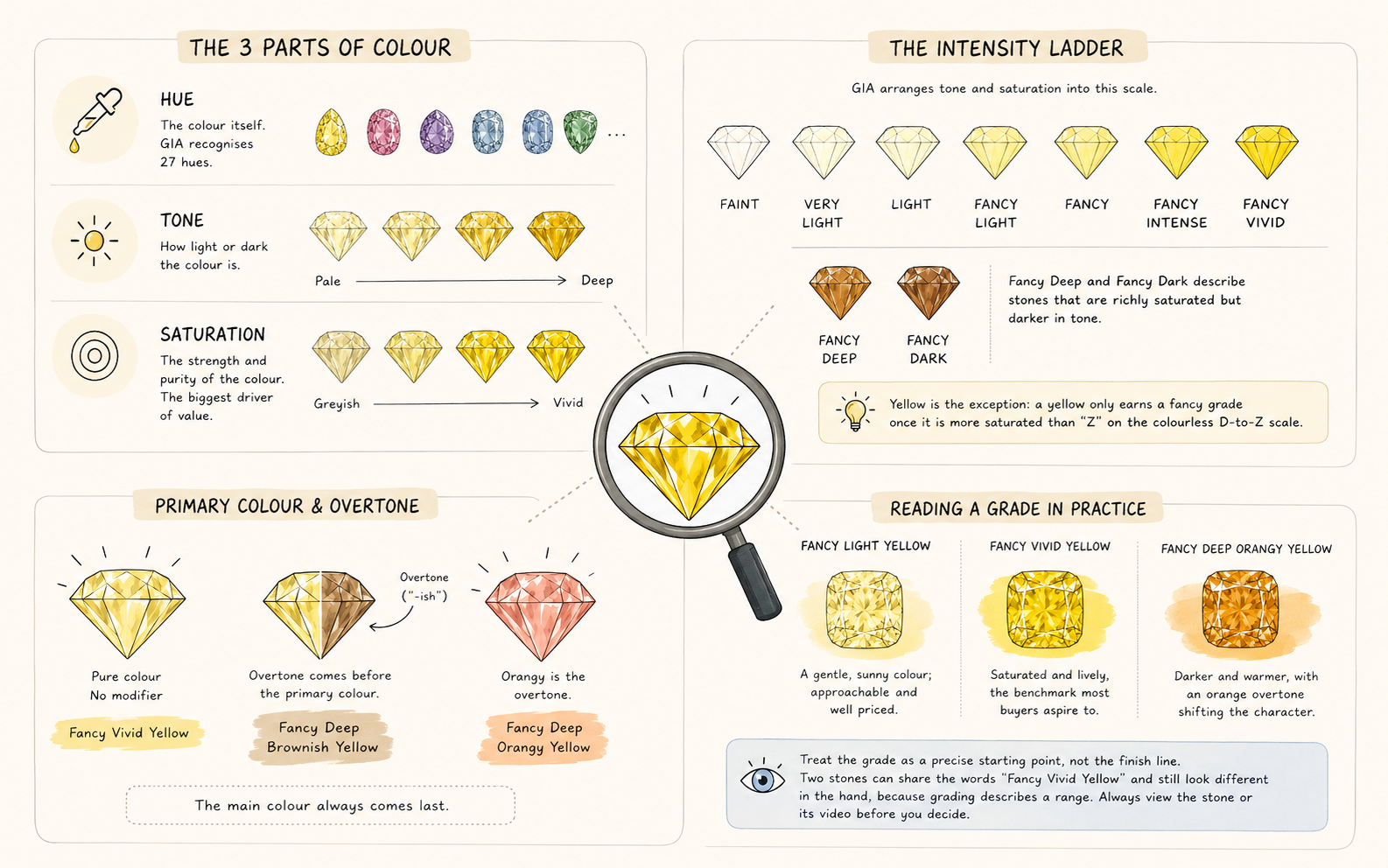
- Hue is the colour itself. GIA recognises 27 hues, from familiar yellows and pinks to subtle names like "orangy yellow" or "violetish blue."
- Tone is how light or dark the colour is, from pale to deep.
- Saturation is the strength and purity of the colour — how vivid versus how greyish or brownish. Saturation is the single biggest driver of value.
The intensity scale
GIA arranges tone and saturation into one ladder: Faint, Very Light, Light, Fancy Light, Fancy, Fancy Intense, Fancy Vivid. Two further grades — Fancy Deep and Fancy Dark — describe stones that are richly saturated but darker in tone. Yellow is the exception that proves the rule: a yellow only earns a fancy grade once it is more saturated than "Z" on the colourless D-to-Z scale.
For most buyers, the words that move the price are Fancy Intense and Fancy Vivid.
Primary colour and overtone
Few stones are a single pure hue. A secondary colour, the overtone, is written with an "-ish" ending before the main colour — and the main colour always comes last. So "Fancy Brownish Yellow" is a yellow diamond with a brown overtone. A pure "Fancy Vivid Yellow" with no modifier is rarer, and dearer, than a "Fancy Deep Brownish Yellow" of the same size.
Reading a grade in practice
- Fancy Light Yellow — a gentle, sunny colour; approachable and well priced.
- Fancy Vivid Yellow — saturated and lively, the benchmark most buyers aspire to.
- Fancy Deep Orangy Yellow — darker and warmer, with an orange overtone shifting the character.
Treat the grade as a precise starting point, not the finish line. Two stones can share the words "Fancy Vivid Yellow" and still look different in the hand, because grading describes a range. Always view the stone or its video before you decide.
← All primers